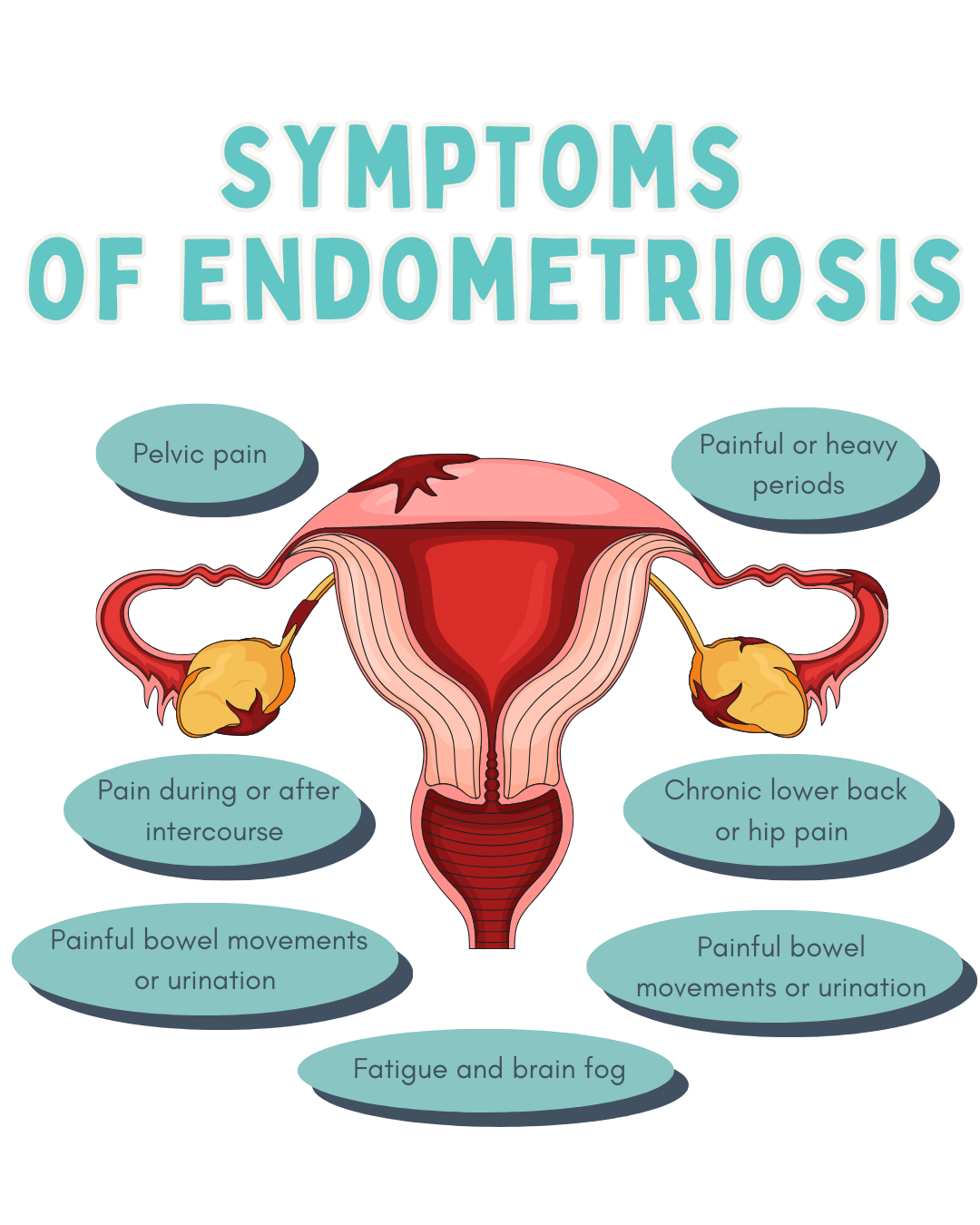
If you have been told to just deal with pelvic pain, you are not alone. Many people with endometriosis spend years seeking answers before receiving a diagnosis, often feeling dismissed along the way. At PRM, we understand the challenges of living with endometriosis and how long and frustrating that journey can be. Our mission is to educate patients about endometriosis and the pelvic pain it causes, and to provide a place where your symptoms are taken seriously and your experience is validated.

Severe cramping or pain during your period that causes you to miss school, work, or any activities you enjoying participating in.

Pain experienced during your period may involve cramping, abdominal pain, back pain, rectal pain, and more.

Experiencing extreme pain during and after penetration.

Heavy bleeding during your period.
Endometriosis can be confusing because there isn’t one clear cause, and many people spend years searching for answers. While the exact reason it develops isn’t fully understood, what matters most is that the pain and symptoms are real and deserve to be taken seriously. Some of the most common explanations include:
Some experts believe cells that normally line the abdomen and pelvis may change over time, influenced by hormones or the immune system, and begin acting like endometrial tissue.
Another theory suggests that certain cells present before birth may later change during puberty and develop into endometrial-like tissue.
After surgeries involving the uterus, such as a cesarean section or hysterectomy, endometrial cells may attach to nearby tissue or scar areas and continue to grow there.
Some researchers believe endometrial cells may travel through the body and settle in other areas, which may explain why endometriosis can sometimes appear outside the pelvis.
Another explanation is that the immune system may not recognize or clear away endometrial tissue growing outside the uterus, allowing it to remain and cause symptoms.
Endometriosis pain can look different for everyone. Some people experience constant discomfort, while others have pain that comes and goes or worsens over time. Because many people are told their pain is normal, it can be difficult to know when symptoms deserve more attention. Our pain score quiz can help you better understand how your symptoms are affecting your daily life and whether it may be time to explore additional support.
Endometriosis can only be definitively diagnosed by examining tissue under a microscope, which requires surgery, most commonly a laparoscopy. Because of this, many patients consider or undergo excision surgery as part of their care. At PRM, many of the patients we see come to us with symptoms of endometriosis, and we understand how complex and personal these treatment decisions can be. We believe people living with endometriosis deserve a comprehensive approach to care and a team that works closely with excision surgeons, with the goal of helping patients manage symptoms effectively while reducing the number of surgeries they may need over their lifetime.
First, our providers will ask questions about your medical history and listen to your symptoms to get a full picture of what is going on with you.
Next, an external exam of your hips, abdomen, and posterior sacrum.
Next, your pelvic nerves are evaluated externally with a soft cotton tip.
Next, with your consent, gel is placed on a gloved finger and an internal exam is performed to allow us to evaluate the nerves and muscles within the pelvis. There is no speculum required as we are evaluating the pelvic floor muscles and nerves not the organs.
Sometimes patients will need Imaging to help us understand if there is an associated cause of the pelvic nerve and muscle pain and dysfunction found on exam.
Oftentimes, treatment can be started the same day as there is no down time. Our patients have been suffering with pelvic pain symptoms for 6+ months. We like to get them on the road to feeling better as soon as we can as the longer the symptoms are present the harder it is for us to resolve them.
Treatment for endometriosis can look different for each person and often involves a combination of approaches depending on symptoms, goals, and how pain is affecting daily life. Many patients searching for an endometriosis cure are surprised to learn that treatment typically focuses on managing symptoms, improving function, and addressing the underlying disease through a personalized care plan. Common treatment options may include medication to help manage pain or hormone-related symptoms, pelvic floor symptoms, and in some cases, surgery to remove endometriosis through excision.
While surgery can play an important role for many patients, it is not always the only part of care. Pelvic nerve sensitivity and muscle dysfunction can continue to contribute to pain before or after surgery, which is why many patients benefit from a comprehensive approach that also focuses on improving pelvic muscle and nerve function.
At PRM, care is centered around supporting patients through this broader approach, working alongside excision surgeons when appropriate and focusing on helping patients manage pain, improve function, and reduce the long-term impact of pelvic pain.
We understand that many people spend years searching for answers before finding the right care team. Whether you are newly learning about endometriosis or have been managing symptoms for years, our goal is to provide education, validation, and treatment options that help you move forward with confidence.
If you would like to learn more about your options or speak with our team, we invite you to complete our contact form and a member of our team will reach out to help guide your next steps.