With expert input from Dr. Christopher Kliethermes, Gynecologic Surgeon in at PRM in Troy, Michigan
Uterine fibroids are a very common diagnosis for patients in the US. Approximately 80% of women will have fibroids during their reproductive years. Patients will suffer from a variety of issues, including abnormal bleeding, increased pressure on organs, and infertility.
When it comes to uterine fibroid treatment, there are a variety of options. There are non-surgical fibroid treatments with some natural remedies for fibroids, radiological interventions for fibroids (that include uterine fibroid embolization), radiofrequency ablation of fibroids, minimally invasive fibroid treatment, and more invasive treatment for fibroids.
Non-Surgical Treatment Options for Fibroids
Non-surgical treatment options include hormonal therapy for fibroids and some non-hormonal options:
Hormonal Options
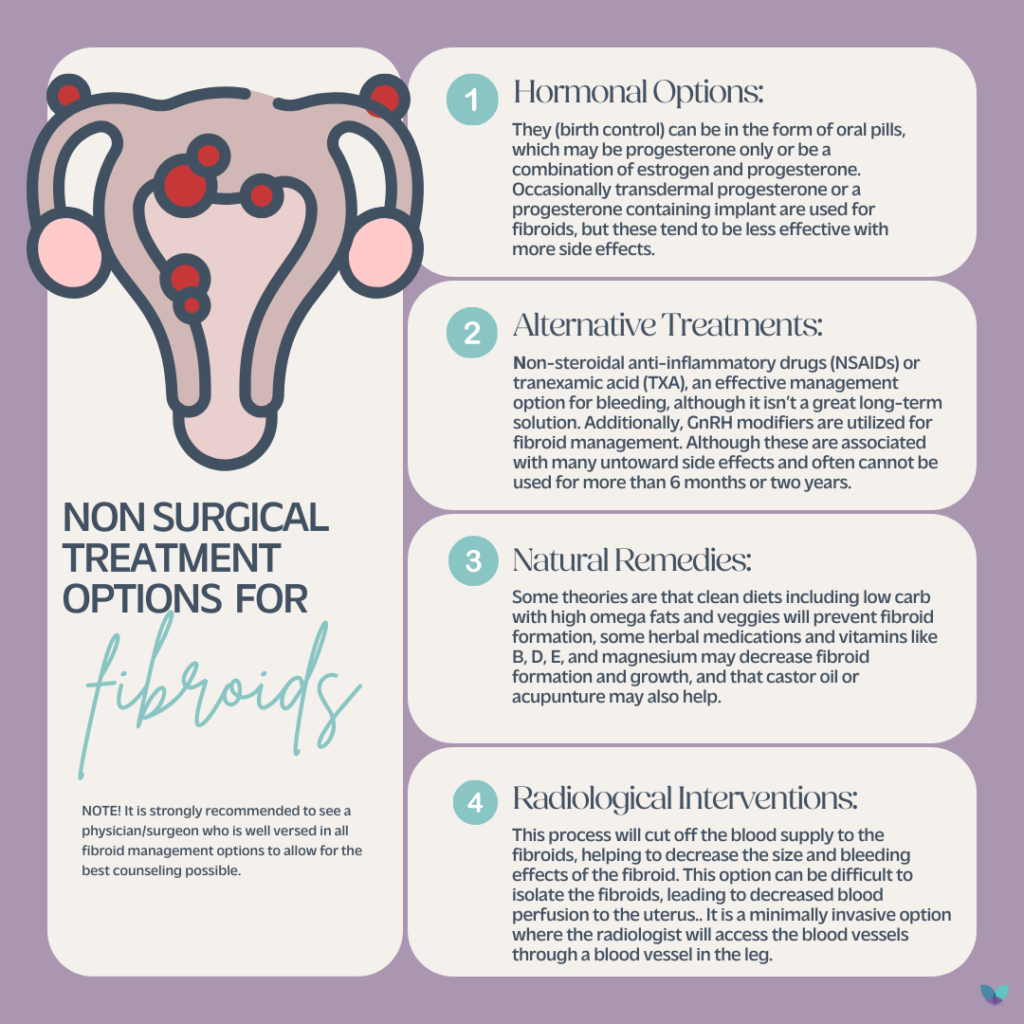
Hormonal options most commonly are different forms of birth control. They can be in the form of oral pills, which may be progesterone only or be a combination of estrogen and progesterone. Occasionally, transdermal progesterone or a progesterone-containing implants are used for fibroids, but these tend to be less effective with more side effects. An injectable progesterone can also be used, but it sometimes takes a couple of doses every 3 months before the bleeding is improved.
There can be side effects from any form of hormonal treatment, but injectable progesterone is more associated with weight gain due to appetite stimulation. One of the most effective forms of hormonal treatment is a progesterone intrauterine device (IUD). These can decrease bleeding in up to 70% of women with minimal side effects and can often lead to no bleeding at all while the IUD is in place.
Alternative Treatments
Some alternative treatments for fibroids can include non-steroidal anti-inflammatory drugs (NSAIDs) or tranexamic acid (TXA). Although less effective for bleeding issues, NSAIDs can also be helpful for pain management for fibroids. TXA is an effective management option for bleeding, although it isn’t a great long-term solution.
Occasionally, GnRH modifiers are utilized for fibroid management. Although these are associated with many untoward side effects and often cannot be used for more than 6 months or two years. Side effects are the typical symptoms associated with menopause and some additional concerns.
Sometimes providers will use these medications to “shrink” fibroids, but from Dr, Kliethermes’ experience, this can complicate surgical management more than help.
Natural Remedies
Some natural remedies have been theorized but have not been proven with medical studies to improve fibroid symptoms or decrease their occurrence.
- One thought is clean diets will help prevent fibroid formation, including a low-carb diet with high omega fats and vegetables.
- Some herbal medications and vitamins are also theorized to decrease fibroid formation/growth. They can include vitamins B, D, E, and magnesium
- Occasionally, castor oil or acupuncture may be considered.
All non-surgical options are used to treat abnormal uterine bleeding, but unfortunately, fibroids can pose more than just bleeding issues due to their size. Larger fibroids can press on organs and nerves, causing medical issues and pain.
Radiological Interventions
Occasionally, women will be referred to radiological interventions for fibroids, or uterine fibroid embolization. This process will cut off the blood supply to the fibroids, helping to decrease the size and bleeding effects of the fibroids. This option can be difficult to isolate the fibroids, leading to decreased blood perfusion to the uterus. Thus, women need to have completed childbearing for this option. Side effects can last a few months to years, including pain and foul discharge. It is a minimally invasive option where the radiologist will access the blood vessels through a blood vessel in the leg.
Surgery for Fibroids
Surgically, there are multiple minimally invasive fibroid treatments available. One option, depending on the location and size of the fibroids, would be hysteroscopic myomectomy. This would be appropriate for submucosal (inside the uterine cavity) fibroids that are of a certain size. Larger fibroids can make this approach challenging, but most fibroids that are accessible from inside the uterine cavity can be removed through this approach. Sometimes it does involve two or more surgeries to completely remove the entire fibroid safely.
New Fibroid Treatment Options
Two of the newer and innovative fibroid treatments are the radiofrequency ablation (RFA) options. These options are known as Sonata Fibroid Treatment and Acessa Fibroid Treatment. These devices are transcervical (through the cervix and vagina) or transabdominal (through laparoscopic surgery and the abdomen) routes to treat fibroids, respectively. The devices will deploy “probes” into the fibroid and transmit radio waves to denature the proteins of the fibroids. This has been shown to decrease the size of the fibroid and bleeding from the fibroid. This process is less invasive, and studies are ongoing to prove safety with pregnancy after these treatments. Limitations of this procedure are that they are much less effective on larger fibroids (greater than 6-8cm) and only provides 50% reduction in size by volume. Which means a 6cm fibroid might shrink to only 4-5 cm because most of the volume is on the outside of a sphere (or the fibroid).\
What is the best option for fibroids treatment?
The gold standard for surgical treatment is and remains laparoscopic myomectomy surgery for fibroids. This is a minimally invasive fibroid treatment that is a process to remove the entire fibroid.
Although minimally invasive, there is a greater impact on the uterus, as it does involve one or more incisions on the uterus. The benefits of myomectomy are similar to the above, with decreased bleeding, but it has the added benefit of completely removing the entire fibroid. This can significantly improve the mass effect of fibroids. The downside is that it does involve one or more incisions on the uterus. This might lead to increased blood loss compared to RFA and may also then require cesarean delivery for future pregnancies.
Additional Options for Treating Fibroids
Laparoscopic Hysterectomy
Another minimally invasive option to remove fibroids would be a laparoscopic hysterectomy. This is like a myomectomy, as it does involve removing the fibroids, but would also include removing the uterus with the fibroids. The benefits of this option are that it nearly eliminates the possibility of fibroid recurrence, tends to have less blood loss, and has fewer complications from the surgery. Because it involves removing the uterus, patients should have completed childbearing before moving to this option.
Incision Myomectomy or Hysterectomy
The last option is an open incision myomectomy or hysterectomy, which is the other fibroid removal option. This involves usually a cesarean section type incision or an incision from the top to the bottom of the abdomen. This tends to lead to longer recovery times and higher blood loss. The benefit would be that the surgeon can feel the uterus with their hands to sometimes remove many smaller fibroids for a myomectomy that may not have been found otherwise. Some surgeons who don’t have the training or feel comfortable performing minimally invasive options for larger fibroids may recommend this option.
Conclusion
Comparing these fibroid treatment options can be challenging and does require a consultation with a physician. It would be strongly recommended to see a physician/surgeon who is well-versed in all these options to allow for the best counseling possible. Dr. Kliethermes believes that all fibroids, no matter the size, can be treated with a minimally invasive option. He also feels that all patients deserve a complete informed consent regarding all the options, to best treat each patient.