PRM’s University Health Initiative Featured in Fierce Healthcare

PRM was featured in Fierce Healthcare for launching the University Health Initiative, a national partnership with Project Endo. The program gives colleges free educational resources, a validated screening tool, and referral pathways for students with endometriosis symptoms. Endometriosis affects up to 1 in 10 women, yet diagnosis still takes an average of 4–11 years — college is often when symptoms first surface. Founding university partners include MIT, Johns Hopkins, Howard, Penn, Emory, and George Mason, with more expected to join
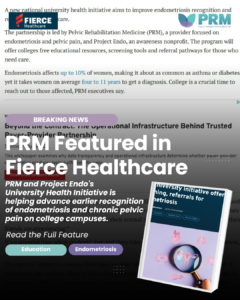
We’re thrilled to share that Pelvic Rehabilitation Medicine (PRM) was recently featured in Fierce Healthcare, one of the country’s leading healthcare industry publications, for the launch of our new University Health Initiative, a national partnership with endometriosis awareness nonprofit Project Endo designed to help college students get diagnosed and treated faster.
Read the full article here: New University Initiative Offers Screening, Referrals for Endometriosis (Fierce Healthcare)
Endometriosis affects as many as 1 in 10 women – making it roughly as common as asthma or diabetes. Yet on average, it still takes four to eleven years for someone to receive an accurate diagnosis. For many, those years of confusion, dismissed symptoms, and misdiagnosis begin exactly when they’re navigating life on a college campus for the first time.
According to PRM co-founder and Chief Medical Officer Dr. Allyson Augusta Shrikhande, college is often the moment students first start noticing that what they’re experiencing isn’t “normal” compared to their peers. Between new independence, academic stress, disrupted sleep, and changing routines, it’s also a common time for symptoms to flare.
That’s exactly the gap the University Health Initiative was built to close.
Through this new partnership, participating colleges and universities gain access to:
The goal, as Dr. Shrikhande put it, is to make identifying endometriosis “more of a science than an art.”
Founding university partners include MIT, Johns Hopkins University, Howard University, University of Pennsylvania, Emory University, George Mason University, and several others – with more institutions expected to join as the program expands.
The traditional path to an endometriosis diagnosis has long relied on diagnostic laparoscopy — a surgical procedure that can be costly and often delays care. Updated guidance from the American College of Obstetricians and Gynecologists (ACOG) now supports using patient history, symptom review, and physical exam findings to reach a presumptive diagnosis sooner, without waiting on surgery to confirm what patients are already telling their providers.
At PRM, we’ve also long believed that treatment shouldn’t stop at surgery. Because endometriosis is a systemic inflammatory condition, our approach addresses:
This whole-person approach is central to how PRM treats every patient — and now, thanks to the University Health Initiative, we’re able to reach students at the exact moment they need us most.
Are you a university health professional, campus leader, or student looking to bring these resources to your school? Learn more and access screening tools at pelvicrehabilitation.com/university or projectendo.org.
At PRM, we believe no one should have to wait a decade for answers. This initiative is one more step toward a future where endometriosis is recognized early, treated properly, and taken seriously — starting on college campuses across the country.
Read the original Fierce Healthcare coverage here.
The University Health Initiative is a national partnership between Pelvic Rehabilitation Medicine (PRM) and Project Endo, designed to help college campuses recognize the signs of endometriosis and connect students to specialist care sooner.
Participating universities receive free educational materials for campus health staff, a validated screening questionnaire developed by a PRM surgeon, and clear referral pathways to PRM’s specialty centers or other local care options, including telehealth for students outside a PRM service area.
Founding university partners include MIT, Johns Hopkins University, Howard University, University of Pennsylvania, Emory University, and George Mason University, with additional institutions expected to join as the initiative expands.
The screening tool is a questionnaire covering symptoms, menstrual history, and bowel and bladder history. Based on the responses, students receive a score ranging from mild to severe, helping campus health staff determine appropriate next steps for referral.
College is often when endometriosis symptoms first become noticeable, coinciding with new independence, academic stress, and disrupted sleep and routines. It’s also frequently the first time students compare their symptoms to peers and realize something may be wrong — making it a critical window for early intervention.
Campus health clinicians participating in the initiative can refer students directly to PRM for specialized care, or provide a list of other local care options. For students outside a PRM service area, an initial telehealth visit may be available.
Endometriosis currently takes an average of 4 to 11 years to diagnose, during which patients often experience unmanaged pain and are sometimes misdiagnosed with conditions like irritable bowel syndrome. Earlier recognition allows patients to start appropriate treatment sooner, which can improve long-term outcomes.
University health professionals, campus leaders, and students can learn more and access program resources at pelvicrehabilitation.com/university or projectendo.org.