When Period Pain Isn’t Normal: What a Pelvic Pain Specialist Wants You to Know
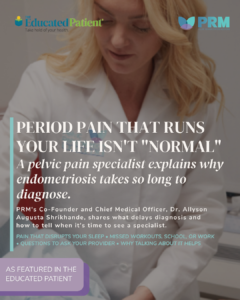
Period pain that disrupts your sleep, your workouts, or your school and work is common, but it is not something you have to live with. That was the message from Allyson Augusta Shrikhande, M.D., Co-Founder and Chief Medical Officer of PRM, in a recent feature in The Educated Patient. She explained why endometriosis takes so long to diagnose and how to tell when pain has gone beyond normal.
Why Endometriosis Is So Hard to Diagnose
Dr. Shrikhande points to three factors that work together to delay diagnosis. She calls them a triad.
- There is no reliable nonsurgical test. Today, surgery is often needed to confirm endometriosis. Dr. Shrikhande says progress is being made, but the gap is still a real barrier.
- Period pain has been normalized. Generations of women have been told that severe period pain is just something to live with. Many people put up with symptoms for years, and often don’t realize their experience is abnormal until they compare notes with others later in life.
- Medical education has lagged. Endometriosis has historically received limited attention in medical school and residency. Dr. Shrikhande, who has practiced since 2012, has seen awareness grow among residents and medical students, but says it still isn’t prioritized in the curriculum the way it should be.
Confirming endometriosis often takes surgery, but you don’t have to wait for that to start a conversation with a specialist.
When Period Pain Isn’t Normal
Dr. Shrikhande encourages patients to pay close attention to how pain affects daily life. Pain has moved beyond what should be considered normal if it:
- Interferes with your sleep
- Keeps you from going to an exercise class
- Makes you miss school, work, or social activities
If that sounds familiar, it’s time to talk with a specialist. PRM’s endometriosis symptom quiz is a place to start.
How to Prepare for the Conversation
Dr. Shrikhande stresses the value of seeing someone who focuses specifically on pelvic pain and endometriosis, rather than a general provider. She also recommends arriving with questions ready:
- Do my symptoms sound consistent with endometriosis or adenomyosis?
- Can you walk me through your diagnostic reasoning?
It also helps to jot down when pain disrupts your day, so you can describe how it affects your sleep, activity, school, or work.
Changing the Conversation Around Period Pain
PRM’s mission is to shorten how long patients suffer before they get appropriate care, and Dr. Shrikhande credits public education efforts with helping shift that timeline. She encourages women to talk more openly about period pain with friends, mothers, and other family members. Reducing the stigma and silence around menstrual symptoms, she says, is essential to broader change.
In her view, the goal is to normalize the conversation, not the pain.
Frequently Asked Questions
Is severe period pain normal? It is common, but it is not something you have to live with. Dr. Shrikhande says pain that interferes with sleep, exercise, school, work, or social activities has moved beyond normal and deserves a conversation with a specialist.
Why does endometriosis take so long to diagnose? Three factors work together: there is no reliable nonsurgical test, period pain has been normalized, and endometriosis has received limited attention in medical education.
Can endometriosis be diagnosed without surgery? Right now there is no reliable nonsurgical test, so surgery is often needed to confirm it, though progress is being made. A specialist can still evaluate your symptoms and history and talk through next steps with you.
What should I ask at my appointment? Ask whether your symptoms sound consistent with endometriosis or adenomyosis, and ask your provider to explain their diagnostic reasoning.
Should I see a specialist? Dr. Shrikhande recommends seeing a provider who focuses specifically on pelvic pain and endometriosis, rather than a general provider.
How PRM Can Help
If your period pain is getting in the way of your life, the PRM team is here to listen. We specialize in endometriosis, adenomyosis, and chronic pelvic pain, with locations across the United States. Request an appointment or find a location near you.
Read the full article by Lana Pine at The Educated Patient.
This article is for general education and isn’t a substitute for personalized medical advice.
We hear you. We see you. We believe you.
Pelvic Rehabilitation Medicine
Frequently Asked Questions
It is common, but it is not something you have to live with. Dr. Shrikhande says pain that interferes with sleep, exercise, school, work, or social activities has moved beyond normal and deserves a conversation with a specialist.
- Why does endometriosis take so long to diagnose?
Three factors work together: there is no reliable nonsurgical test, period pain has been normalized, and endometriosis has received limited attention in medical education. - Can endometriosis be diagnosed without surgery?
Right now there is no reliable nonsurgical test, so surgery is often needed to confirm it, though progress is being made. A specialist can still evaluate your symptoms and history and talk through next steps with you. - What should I ask at my appointment?
Ask whether your symptoms sound consistent with endometriosis or adenomyosis, and ask your provider to explain their diagnostic reasoning. - Should I see a specialist?
Dr. Shrikhande recommends seeing a provider who focuses specifically on pelvic pain and endometriosis, rather than a general provider.
Three factors work together: there is no reliable nonsurgical test, period pain has been normalized, and endometriosis has received limited attention in medical education.
Right now there is no reliable nonsurgical test, so surgery is often needed to confirm it, though progress is being made. A specialist can still evaluate your symptoms and history and talk through next steps with you.
Ask whether your symptoms sound consistent with endometriosis or adenomyosis, and ask your provider to explain their diagnostic reasoning.
Dr. Shrikhande recommends seeing a provider who focuses specifically on pelvic pain and endometriosis, rather than a general provider.