If you experience symptoms like fatigue, joint pain, or unexpected digestive or thyroid issues alongside your endometriosis, you’re not imagining things. New 2025 research shows a clear link between endometriosis and autoimmune conditions—confirming what many patients have long suspected.
What the Research Found
1. Increased Autoimmune Risk
A major Oxford University study analyzed over 8,000 women with endometriosis using UK Biobank data. The findings?
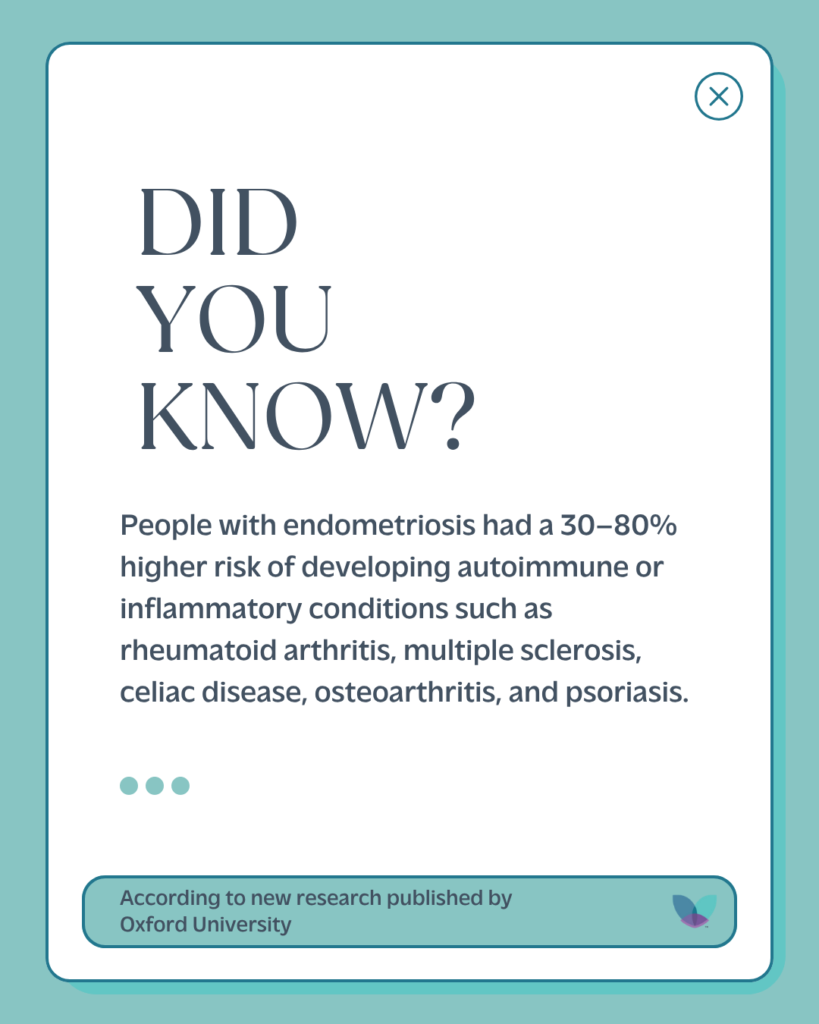
People with endometriosis had a 30–80% higher risk of developing autoimmune or inflammatory conditions such as rheumatoid arthritis, multiple sclerosis, celiac disease, osteoarthritis, and psoriasis.
2. Genetic Overlap
The same study identified shared biological pathways between endo and certain autoimmune diseases—specifically osteoarthritis, rheumatoid arthritis, and multiple sclerosis—suggesting a possible causal link between endo and rheumatoid arthritis (odds ratio ≈ 1.16).
3. Clinical Diagnosis Data
A separate analysis of medical records for over 332,000 women with endometriosis found:
Within two years of an endo diagnosis, 4.5% were diagnosed with an autoimmune condition—compared to 1.3% in women without endo.
Overall, the odds of getting an autoimmune diagnosis were about twice as high in the endo group. Specific conditions like Sjögren’s syndrome or myositis showed up to six times higher odds.
In practical terms:
- Risk of having at least one autoimmune disease increased by 14%
- Risk of having two autoimmune conditions increased by 21%
- Risk for three autoimmune conditions increased by 30%
Why This Matters
Your symptoms are valid. Experiencing fatigue, joint stiffness, brain fog, or skin issues along with endo is not a coincidence—it may indicate a broader immune response.
- Endometriosis may be systemic, not just pelvic. These findings reinforce that the condition can affect your body as a whole.
- Timing matters. Multiple autoimmune conditions often develop within two years after an endometriosis diagnosis.
- Broader care matters. This may justify pursuing autoimmune screening if you notice symptoms beyond typical menstrual pain.
What You Can Do Now
If you have symptoms like fatigue, joint pain, skin rashes, gut issues, or thyroid changes, it might help to ask your provider about autoimmune screenings. Consider a whole-person approach—instead of treating symptoms in isolation, aim for coordinated care that bridges pelvic health, immune system, and mental well-being.
Join supportive communities where others navigate similar experiences—you’re not alone in this.
At PRM, We See You and Hear You
This 2025 research says loud and clear: endometriosis and autoimmune disease are connected—genetically, biologically, and clinically. At PRM, we prioritize care that reflects all parts of you, not just one symptom or system. Because you deserve to heal from the inside out.
Sources
- Oxford University News. (2025, April 28). New research reveals shared genetic link between endometriosis and immune conditions. University of Oxford. https://www.ox.ac.uk/news/2025-04-28-new-research-reveals-shared-genetic-link-between-endometriosis-and-immune-conditions
- Laganà, A. S., et al. (2024, July 8). Evaluating shared genetic mechanisms between endometriosis and immune-mediated inflammatory diseases: a Mendelian randomization study. medRxiv. https://www.medrxiv.org/content/10.1101/2024.07.08.24310092v1
- ReachMD. (2025). Endometriosis and Autoimmune Conditions: Insights Into Shared Inflammatory Pathways. https://reachmd.com/news/endometriosis-and-autoimmune-conditions-insights-into-shared-inflammatory-pathways/2475318/
- Verywell Health. (2025). Is Endometriosis Genetic? New Study Says Yes—and May Be Linked to Autoimmune Conditions. https://www.verywellhealth.com/is-endometriosis-genetic-11700870
- Contemporary OB/GYN. (2025, May 1). Endometriosis linked to higher risk of autoimmune diseases. https://www.contemporaryobgyn.net/view/endometriosis-linked-to-higher-risk-of-autoimmune-diseases