From Silenced Patient to Physician-Founder: Dr. Allyson Shrikhande’s Story
Before she was PRM’s Co-Founder and Chief Medical Officer, Dr. Allyson Augusta Shrikhande was a physician who couldn’t get her own healthcare system to listen to her.
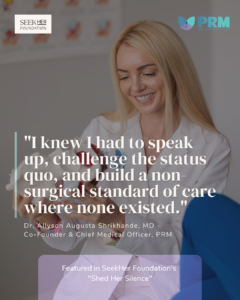
She recently sat down with SeekHer Foundation for their “Shed Her Silence” series – a collection of conversations with women leaders about the moments that shaped their work. Dr. Shrikhande’s interview covers the experience that led her to found PRM, what emotional equity actually means in healthcare, and the next chapter of that work: bringing endometriosis education directly to college campuses.
A Physician, Dismissed By Her Own Field
After the birth of her first daughter, Dr. Shrikhande developed severe postpartum pelvic pain. Despite her medical background, her marriage to a leading surgeon, and access to some of the best healthcare in the country, she found herself facing the same dismissal so many patients describe: invasive surgery, or learn to live with it.
There’s something specific about that combination – a physician, in Manhattan, married to a surgeon — that makes the story land differently. It wasn’t a lack of access, or a lack of medical literacy, or a lack of advocacy skills that left her without answers. It was a systemic gap in how the healthcare field is trained to recognize and treat pelvic pain in the first place.
What turned that experience into something bigger, she explained, was a simple but sobering realization: if someone with her training, her network, and her resources could be told to just accept the pain, patients without any of those advantages had even less of a chance of being heard. That recognition became the starting point for PRM’s entire approach to care.
Building a Different Standard
Dr. Shrikhande has described the mission plainly – to build a non-surgical standard of care where one didn’t already exist. She points to a telling statistic from her own training: the average OB-GYN receives only three to five hours of dedicated endometriosis education across all of medical school, in a field where symptoms are still routinely normalized as “just part of being a woman.”
That gap isn’t abstract. It’s part of why the average patient with endometriosis waits seven to ten years for an accurate diagnosis – cycling through providers, being told imaging looks “normal,” and often being offered surgery as the only real option, rather than a coordinated, non-surgical path forward.
Her co-founder and husband, Dr. Gautam Shrikhande, a Harvard-trained vascular surgeon and former Assistant Professor of Surgery at Columbia University Medical Center, played a central role in turning that recognition into an actual system. He didn’t just offer support from the sidelines – he brought deep institutional and operational expertise to complement her background in physical medicine and rehabilitation, and together they built PRM’s model from the ground up. In the interview, Dr. Shrikhande credits that partnership directly: having someone who fully validated her experience and helped build the infrastructure to act on it allowed her to move out of survival mode and into clinical leadership.
What Emotional Equity Looks Like in Practice
One of the more striking parts of the interview is how Dr. Shrikhande frames the emotional burden patients carry – not just the physical symptoms, but years of coordinating fragmented specialist visits, repeating their history to provider after provider, and having to constantly prove their pain is real just to be taken seriously.
At PRM, she explains, that diagnostic and emotional weight is treated as the practice’s responsibility to carry, not the patient’s. In practice, that means combining an ultrasound-guided treatment protocol with surgical options when needed, alongside integrative nutrition, mindfulness, and behavioral health support – all coordinated under one plan, rather than patients having to piece it together themselves across disconnected specialists.
It’s a reframing worth sitting with: emotional equity isn’t a soft add-on to clinical care. In Dr. Shrikhande’s telling, it’s what happens when a system stops requiring patients to exhaust themselves proving their own pain before anyone will actually treat it.
The Next Generation: University Health Initiative
The interview closes on what Dr. Shrikhande is building next: the University Health Initiative (UHI), launched in partnership with Project Endo.
Since endometriosis symptoms often begin in adolescence or young adulthood, this initiative is built to catch the problem far earlier than most patients currently experience. PRM and Project Endo are delivering free screening toolkits, clinical training, and clear care pathways directly to university health centers – including George Mason University, Georgetown, NYU, Columbia, Princeton, the University of Florida, the University of Miami, and Vanderbilt.
The logic behind it mirrors Dr. Shrikhande’s own story: young women on college campuses are already living through academic disruption, mental health strain, and normalized pain – often without anyone around them, including their own campus healthcare providers, trained to recognize what’s actually happening. By training those providers directly, UHI is designed to shorten the diagnostic delay before it has years to compound.
Why This Story Matters Beyond PRM
It would be easy to read this as simply a founder-origin story, but the broader point Dr. Shrikhande makes in the interview is bigger than any one practice: healthcare systems routinely fail to validate women’s pain, and that failure isn’t the result of individual bad actors – it’s structural. Recognizing that distinction, she notes, was what allowed her to stop seeking validation from a framework that was never built to provide it, and instead build something new.
That’s also, ultimately, the throughline of PRM as an organization – not just a treatment protocol, but an operating philosophy that patients shouldn’t have to fight to be believed before they can start healing.
Read the Full Conversation
Dr. Shrikhande’s full interview covers more than what’s captured here – including how she thinks about psychological safety in medicine, and what it took to move from feeling isolated in her own diagnosis to building an entire system around not letting that happen to anyone else.
Read the full feature on SeekHer Foundation →
Want to learn more about the care model built from this experience? Learn about the PRM Protocol™ or request an appointment with the PRM team.
We hear you. We see you. We believe you.